Wednesday, September 28, 2011

Saleh's Empty Promises


With the announcement that President Ali Abdullah Saleh will allow for new elections in order to facilitate a peaceful transition. But in his speech that addressed the entire nation, he calls protestors terrorists and agents of Al-Qaeda. This not only angered protestors, but has and will spark more violence and protests. It’s a slap in the face to the Yemeni people. I do not see how one can call the people protesting terrorists, when the violence is being caused by the governments own men, their own army. Violent crackdowns are on the rise and this is not a good sign for a peaceful transition, no matter how much it is wanted. With violence increasing since Saleh’s arrival back in Yemen, hopes for a peaceful, stable conversion of power have all but vanished. 
President Ali Abdullah Saleh shown here giving his first speech since arriving back in Yemen.


                But one would hope that maybe elections might work, that maybe if events do not deteriorate too quickly, maybe the elections will actually lead to change. But really, that does not look like it will happen. Recently, Saleh has announced that once allies who defected to the opposition will not be allowed to run in the elections if they are to be had. His reason?  "If we transfer power and they are there, this will mean that we have given in to a coup. If we transfer power, and they are in their positions, and they are still decision makers, this will be very dangerous. This will lead to civil war." 


                Really Saleh? Really? You’re saying you don’t want to give into a coup huh? Are you blind? Are you freaking blind, do you not see the thousands of people rallying in the streets, putting their lives on the line, on hold, just to protest you?! It seems the same veil of blind power has fallen over Saleh’s face as it has over Gaddafi’s and Assad’s. Civil war may very well break out not due to supposed coups and “unfair” elections. Unfair elections have happened for years. No, civil war will break out because the Yemeni people are getting frustrated with the lack of progress from Saleh and the increased violence from the government. This is what happened in Libya, and this may very well happen in Yemen. And if this happens in Yemen, it could be much, much worse. Al Qaeda’s known to be strong in the south and tribal rivalries often lead to outbreaks of violence. With such a volatile society already, a civil war may be the worst thing for Yemen right now. But sadly, it might be the only way.

Thursday, September 22, 2011

Violence in Yemen Reflects True Intentions


At the time of this post, Yemen is in chaos as violence and death mar any sort of hope for a power transfer. Yet hopes for a power transfer are rising as it was just recently announced that Ali Abdullah Saleh has authorized the vice president, Abdrabuh Mansur Hadi, to begin talks with the opposition about a power transfer. This seems like a wonderful turn of events, the evil president finally realizing his wrong ways and trying to step down while he can. But that is the romanticized view. In reality, he hasn’t authorized the vice president to sign any agreement that comes out of those talks. (That sneaky jerk) Once again, Saleh shows his knack for political survival.

A defected soldier is rushed to the hospital after being wounded in a firefight against loyalist gunmen. [AFP]

But while a power transfer might finally be in sight, violence is still breaking out all over Yemen. The past couple of days have seen (at the moment) 89 killed, including children and a 10-month old baby girl. What sort of person shells and kills innocent civilians? What kind of person kills a baby girl? Why is this allowed to happen? The injustice of it all, the horrible mistreatment of human beings is unnerving and it really shows the influence a dictator can have. He can brainwash his forces to commit unspeakable acts.


While the army shells its own people, others in the army realize what is happening. General Ali Mohsen al Ahmar and forces loyal to him have been protecting protestors in recent gatherings in Sanaa. Having pledged  loyalty to the protestors back in March, he has used his authority and troops to hopefully create a buffer between Saleh’s security forces and the people, one that hopefully holds up. But it won’t be enough, and hasn’t been. With supposed closure coming, the actions by Saleh’s forces seem to reveal the real motives of the Yemeni government.

Wednesday, September 21, 2011

The Lost Revolution


While it may seem that this blog has been mainly focused on Libya (it has), it is about the entire Arab Spring and the Middle East. So I think it’s time to turn the spotlight on someone else. The country of Yemen has been protesting since the beginning of the Arab Spring, beginning right after the Tunisian revolution and starting with the Egypt revolution. And yet it is still ongoing with almost no ground gained. So what the factor that’s holding back Yemen and didn’t hold back Egypt or Tunisia? Some think it could be western media attention.
          
Yemeni protestors wearing pink headbands to symbolize their peaceful intent as they march on to government offices.
 
The images are the same: Thousands of young, unemployed and struggling youths taking to the streets, opposing a government obviously corrupt and detrimental to any progress. You saw it in Egypt, you saw it in Libya, you saw it in Tunisia, and you see it in Yemen. So why are things taking so long? Abubakr Al-Shamahi believes the lack of western media coverage is affecting international support for Yemeni protestors.

The Western focus on the Arab world in recent months has been on Libya and Syria, with Yemen an unsexy brother in the background. Yemen has only garnered an article here and there when news of Yemeni President Saleh's "imminent" return is leaked, or when anything al-Qaeda-related emerges. Herein lies one of the major problems that Yemenis face in attempting to draw attention to their uprising. There is a fundamental lack of understanding of Yemen, and this has severely affected the media narrative.  

The funny thing is Yemen is the unsexy brother. It’s been pushed to the side as more understood, more relatable and more covered revolutions which have taken the media spotlight. The main thing those revolutions had that Yemen doesn’t weren’t justifiable causes or energetic protestors, but positive media attention. This led to widespread international support. With Yemen, the only things reported on are the bad aspects relating to the presence of Al-Qaeda or the rumors of change.

If there were more reporters, experts, anyone with reliable expertise on Yemen politics that had western contacts, it might be different. But there are not nearly enough Yemeni experts that speak English in order to qualify a major media boom. And that’s kind of sad to be honest, that a revolution has to have enough English in it in order for the west to notice or care about. We should care because of the tyranny, the corruption, the horrible violence, the rampant starvation and poverty. We should seek out information, become informed and ready to spread the word ourselves. We should use this as a call to arms (of sorts), a way to spread news about any revolution, about any cause. Showing solidarity is the best many of us can do, and by spreading the word of what’s happening in Yemen, we do them the most good.

Tuesday, September 20, 2011

Sharia Law and it's Controversy


With the announcement that Libya will have a new government in 10 days’ time, excitement and anxiety are growing. Mahmoud Jibril announced today that the new government is waiting to be revealed until discussions over the number and location of ministries, reports Al Jazeera. With this announcement news of international support for newly liberated countries has come out. The G8 summit will start a program which will inject financial aid into countries like Tunisia and Egypt as well as sending international experts to guide democratic transitions. Both of these announcements bring about questions about the new governments? Will they be truly democratic? How much foreign influence will they allow? And the taboo questions for some Americans: Will it be based of sharia law?

The flag of the National Transitional Council has been raised at the UN headquarters [AFP]

According to this speech from NTC chairman Mustafa Abdul-Jalil, yes it will. And this will surely cause an uproar from many people in the US. Especially if we decide to aid them in any way, that would be crossing the line now wouldn’t it? But is Islamic law as bad as many put it out to be? In this article by Toni Johnson and Lauren Vriens, Islamic law is clearly explained and the controversy over it explained. Yes, there are punishments for crimes that seem cruel and unusual by today’s standards. But these punishments are almost never used. The only time we hear about them is when they are used, because that’s what will get our attention. And that’s the main problem concerning Islamic law and how it’s viewed in the US. The media wouldn’t print a story about how Islamic law is normal and just as justifiable as US law. No, they want to print the story about the bloodthirsty Middle East and its sexist, cruel punishments for petty crimes. But stories like that almost always reflect a radical, fringe group, something that does not in any way reflect the whole. 

Unfortunately, sharia law does seem to lead to a lot of  gender inequality and criticisms often come up. While some can be proven unfounded, many are still bringing about controversy and there does seem to be a problem among Muslim women regarding discrimination. Many outsiders question the restrictions placed on women regarding headscarves and the veiling of their faces. Although many Muslim women protest this, saying it restricts their freedoms and is not up to date with the modern world, others still believe it is an integral part of the faith. Like many other topics, the controversy surrounding the treatment of women under sharia law has good points from both sides, and is ultimately up to the individual on what they decide. But it needs to be said that any democratic government should give the individual the right and freedom to make that choice.

Muslim women wearing the traditional Nijab veil, covering everything but their eyes.

 Islamic law is still under scrutiny, reasonably so. Many countries have sharia law as part of their constitution, a state religion. This is what I think bothers soooo many people, that a religion’s ideals are being wrongfully forced on people. Some countries solve this by going halfsies, and applying sharia only to those who are Muslim, and then still others are completely secular, and Islamic law exists only at the local level. This is what the international community is holding its breath about, what Libya will decide on. At this point it looks like they want some involvement of Sharia in their government, but that’s not so bad. Different levels vary and its not that different than any western laws. But how involved it is in the government is the source of controversy, something the NTC has recognized and wishes to converse about with its people. And as long as they make sure they’re doing what the people want, that’s fine by me.

Sunday, September 18, 2011

International Reactions: So far so good?


With heavy fighting still ongoing, the NTC in Tripoli is asserting itself rather well on the international front. Reactions to the new leadership are generally positive and supportive, with support coming from both the UN. and the U.S. But with the international support comes a greater spotlight, which has highlighted some internal problems. Whether these will stand in the way of any new government decisions still needs to be seen.

            First of all, the UN. The UN has just recently shown strong support for the NTC by handing Libya’s UN seat over to the NTC. Along with this, they have lifted a few sanctions imposed on the country from when Gaddafi was still in power, thus providing a way for the NTC to start the economy back up. Removing sanctions against large national oil companies such as the Libyan National Oil Corporation are a big step in order for the NTC to make Libya economically independent and stable once again. This is highly important if the NTC wants any chance of succeeding. Without this strong international support, the economy would flop and any chance of a productive government would cease to exist.

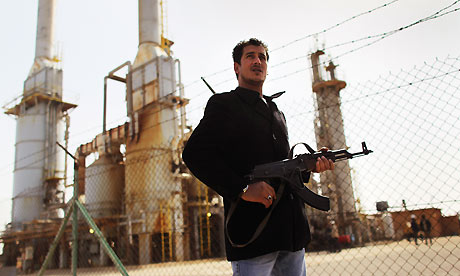
A rebel militiaman stands guard at a Libyan oil refinery in Al Brega. Photograph: John Moore/Getty Images

Besides jump-starting the economy, the UN is also focusing on political help towards the interim government. Having set up the UN Support Mission in Libya (UNSMIL), the UN hopes to help in drafting a constitution and in setting up fair, democratic elections. If anything, I think this is one of the most important and most delicate tasks the UN has undertaken. If they succeed in helping the political process while not overstepping boundaries, than it will be a major victory in setting up a new permanent government. I mean look at Egypt. They ousted Hosni Mubarak in February and emergency laws that were to be repealed are still in effect. This just shows how a revolution isn’t over when you get rid of the old, you have to set up the new as well. And although it may not be as bloody a task, it often ends up being the hardest task.
On another important international note, the US has shown their support and praise for how the NTC has handled the transition and security so far. Having officially recognized the NTC a while ago, a US envoy recently visited the interim leaders, where they met and talked about security among other things. And everything seemed to turn out well. Jeffrey Feltman reported that the NTC is doing a good job in organizing and controlling the many armed groups involved in the revolution. Which is a pretty major and important task if you think about it. 

A ragtag bunch of Libyan rebels, passionate yet unorganized.

 Imagine, an entire population rising up in arms against the government. Local groups band together and start fighting authorities in their towns and eventually take local control. This gains momentum and soon ex-military leaders are rallying large groups of rebels in order to launch major offensives against the countries remaining military. (Which is mostly comprised of foreign militants) This and the increased availability of automatic and heavy weaponry in the country create a potentially disastrous environment. Anything and everything could go wrong.
So the fact that they are able to take control and bring all these rebel groups under one flag is a massive step towards a new, unified Libya. And that would be something remarkable.

Friday, September 16, 2011

Foreign Intervention in Libya: A Good Thing?


We’re making progress people, slowly but surely. This time not on the fighting front, but on the political front. Which is arguably more important.
            The NTC is starting to flex its political muscles and foreign leaders are taking notice. Just recently, French President Nicolas Sarkozy and British Prime Minister David Cameron arrived in Tripoli to meet and talk with the new NTC leaders. I think this is huge symbolically if nothing else. It’s more of a ‘Let’s-see-how-you’re-doing-throw-our-support-behind-you’ dealie than anything else. But that’s what Libya needs right now, a good foreign support. If they don’t have that, organizing a clean transition to a new government will be challenging. And it’s not just my opinion either. 
French President Nicolas Sarkozy and British Prime Minister David Cameron with NTC leaders in Tripoli. [Reuters]

Al Jazeera recently interviewed a few Libyans on their views about this. When asked why he thought France and Britain played such a prominent role in the fight, Seraj Eddin Youssef (A 19 year old technology student)   said this: “Apart from the obvious reasons like oil contracts and other economic gain, I also think that both the UK and France realized they missed the boat during the revolutions in Tunisia and Egypt. That is why they now claim such a prominent role in Libya.” This brings up many good points about foreign involvement.
How much needs to happen before foreign powers get involved? Human rights violations were happening long before any intervention, even before any revolution gained traction. So why does it take huge revolutions to bring about intervention where it is so obviously needed? Governments like the U.S. and Britain, and especially international groups like NATO need to realize that they don’t need massive uprisings in order to do what is right. But would it be right?
That’s the problem with all of this. It seems to me many Arab countries would rather deal with it themselves first than accept help. I feel like it’s a pride thing, and that if the tables were turned and it was America, we’d feel the same way. We want to feel like we can do this by ourselves, and only if it gets so terribly bad will we accept help. So there’s the thin line between domineering and helpful. Help too early, you’re too controlling and you’re messing in affairs that don’t concern you. Too late and you ignored obvious human rights violations. Touchy to say the least.
So when Seraj says that France and Britain wanted to get on the boat after they missed Egypt and Tunisia, he’s illustrating that conflict between looking intrusive and looking indifferent. But luckily, they have a chance to stay in that happy-medium. Most Libyans seem to want strong ties with the West economically and politically. This gives the countries a chance to show they aren’t indifferent by supporting the new government with strong political ties and by helping with economic development.
              
Can’t get enough of my riveting opinions on Libyan intervention? (Sarcasm here by the way) No need to fear! Part two of my insightful analysis will be up shortly, covering American response to recent NTC announcements, problems within the NTC, and progress made.  And as always, many thanks to Al Jazeera for their many news articles, many of which are referenced in this post.

Thursday, September 15, 2011

A New Libya?

Keeping up with the current news on Libya, it seems that the NTC (The National Transitional Council) has begun to assert itself as the new government. This is great; it finally seems there might be an end in sight to this bloody civil war. They can establish their own government with the support of foreign nations (The NTC was officially recognized as the Libyan government by the U.S. in July) and finally oust Gaddafi. But that’s the thing. Gaddafi is still out there, he’s not captured, he’s not stopped, and he’s still ‘In control’.

Don't get me wrong, there's no way that he has any sort of control over the country right now, but he’s still out there. There are still battles going on over Sirte (his hometown) and around Bani Walid, so I find it hard to believe that they can completely move on at this point. Because the main thing with those towns is that the support there is hesitant. They don't necessarily support Gaddafi, but they aren't really comfortable with the rebels either. I mean, I'm not sure I would be. A bunch of young men with guns riding into my town, searching for anyone that looks like a loyalist. Shooting into the air celebrating, shooting off large mortar rounds that half of them don't even know how to operate properly. It would be scary.
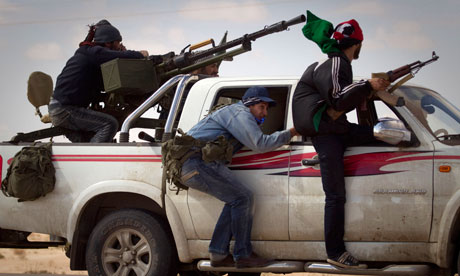
Libyan rebels retreating from a battle while mortars are being fired upon them by Gaddafi forces. Photograph: Anja Niedringhaus/AP

The rebels aren't necessarily viewed as liberators everywhere they go, and I think they have started to realize that. As shown with the negotiations that were held with the residents of Bani Walid, they want to show that they mean no harm to the civilians. They tried their best to assure them that they meant no harm and only wanted to liberate them from the loyalists. But with rumors flying around about indiscriminate profiling of black Africans by the rebels, it seems that some would rather be wary than fully accepting.
Besides the very real problem of facing groups of loyalist fighters, the NTC has political problems they need to worry about. The pressure from the public to take control and fix things NOW is mounting and even though serious political reform will take months, even years, the people are weary of fighting and want change. This is happening as fast as it can and I think a big problem with the revolutions across the Middle East and North Africa is that people expect too much too soon. It’s one thing to overthrow your dictator and assert a democracy. It’s another to make that democracy a productive one and to make serious strides in reform. People do realize this, but a majority are impatient and that will need addressing.
NTC leader Mustafa Abdel Jalil (c) is to meet Cameron and Sarkozy during their trip. Photograph: Mohamed Messara/EPA
All in all, I think it can be said that some progress is finally being made, which is certainly welcome news for anyone currently living in Libya. Although things might not quite happen at the pace people would like for them to happen, it will certainly happen. I'll be keeping an eye on you Libya, and all the things you have to offer