Saturday, December 10, 2011

Delusions of Innocence

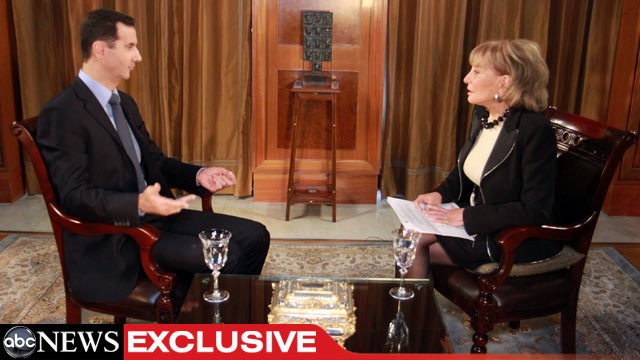
This Wednesday Syrian's President Bashar al-Assad's interview with ABC's Barbara Walters aired for the first time, the first foreign interview since the beginning of the uprisings nearly a year ago. Obviously there would be no way he would own up to the brutal treatment of his own people. But it still comes as a shock and an insult when he said that "OK, we don't kill our people, nobody kill. No government in the world kill its people, unless it's led by crazy person" Really Assad? Only crazy people kill their own people? Then what does that make you? Are you sane then? Because a lot of your people have been dying for some reason and it looks to me like it's caused by your bullets. According to Assad during the interview he is not in the position to give the order to kill, for that would be against the will of the people. He says that the people who have been killed have been government supporters and that there is no majority support for the uprising. Its weird to hear him say this and know for a fact that these statements are wrong. You have to wonder whats hes trying to achieve, whether he believes this or not and even if hes insane. ABC's Barbara Walters seems to thing hes just disconnected from everything that's happening.

Bashar al-Assad sits down with ABC's Barbara Walters to explain his side of the story.

However there is always the fact that he could be carefully trying to manipulate the perception of events going on in Syria. By accepting the interview, he could try to sway the public opinion to his side, although I'm not sure if that's even a reasonable thing to do at all. The world has now seen numerous revolutions where the government plays it off and every time the government is just spreading pathetic propaganda. So i don't see how he could think people would accept his version of events, seeing that they have no proof for his version and that international opinion on Middle Eastern dictators is so harsh right now. (I wonder why?) So that leads me to believe that he really is just disconnected from everything going on OR that he feels he has to at least try to deny it, as a last-ditch hope at international appeasement. If this is the case, then it may not be long before he realizes that the world is not listening to his side of the story, and just decide to say screw it, i'll just go all out. But hopefully that will never happen.

video platformvideo managementvideo solutionsvideo player
Also stated in his interview was that the forces that have been attacking civilians were not his, but the governments. Which is the flimsiest excuse I've heard so far, since with his regime power he basically is the government, whether he likes to admit it or not. And reminiscent of other leaders he also wanted to see proof and view reports made by the UN and other councils over alleged human rights violations. They always want to see the proof, even though it right outside their window. Its like they really expect us to believe that they're that naive. But once again Assad cements this tradition among dictators in the Middle East by saying it is the work of individuals, he has majority support, everyone loves him, blah blah blah. Assad, although seemingly better educated and intelligent, seems to have fallen for the same trap the others have.

The Long Road to Tripoli: Spotlight


Al Jazeera reveals an in-depth look at a group of Libyan revolutionaries as they join the fight against Muammar Gaddafi. Really astonishing and gives a look into how much life changed for these people. I think this does a good job of revealing to us how many of these revolutionaries came from all parts of life to fight for their freedom, and really opens your eyes to the fact that these are all normal people who took up arms. It specifically follows one family in particular that has been in exile in London, and has now made the trip back to Libya to join the fight for freedom. Truly touching tale and one that highlights the obstacles faced by the Libyan revolutionaries as well and personal troubles they had to overcome to get there. A great documentary capturing the human aspect of the war.


Monday, December 5, 2011

Violence Flares in Syria

Once more it seems violence has taken hold of another society, this time Syria's. Violence suddenly flared as kidnappings and deaths rose starting Sunday, with reports of both sides instigating events. Gangs of armed men roamed the streets of Homs abducting people from their homes and killing them, instigating some of the worst violence since the protests in march. This surge in violence is representative of sectarian conflict as Sunni's and Alawites continue to force each other out of homes and towns. This is just yet another happening caused by deeply rooted sectarian tensions in Syria. While protests against the government continue, tensions and conflict between sects often go overlooked as violent surges are thrown in with the violence committed by the government. This could also be true of this occurrence, as more than 25 people have also been killed in Homs by security forces in recent days. Also relating to the violence between Sunnis and Alawites, is that Bashar al-Assad and his top elite are Alawite, while most of the country is Sunni. This rift between the oppressive ruling class and the majority of the country only increases sectarian distrust and tension as many blame each others sect as the cause for problems. This problem can be found in many other Arab countries, where the majority and minority sects and parties often end up hating each other due to political/religious factors.

Protest against the regime of Syrian president Bashar al Assad' . The banner reads: "Sunni, Alawite, Christian, Druze...I am Syrian"   
While this sectional divide may create more conflict as seen in this recent string of kidnappings, often the protestors do not care what minority they are in, they rally around the cause against Assad as one. As seen above, these poplar protests go beyond the sectional tensions, as they are about removing Assad from power and restoring a just democracy rather than majority vs. minority politics, although sometimes it seeps in, as evident here. However despite this, many believe that sectional tensions will fall away under the cause to overthrow Assad. While supporters of Assad might be mostly alawites (due to the ruling class being mainly alawites) many also oppose him and see him as tyrannical. Therefore, it does not simply come down to Sunni vs. Alawite politics.
US ambassador Robert Ford meets with Bashar al-Assad and representatives of the Syrian government.

Another problem with dealing with a country with a clear cut minority/majority aspect is that voices are often dismissed because of sect, religion, tribal affiliations, and whatnot. This problem is one that Hillary Clinton and US ambassador Robert Ford wish to address when he makes his way back to Damascus on Tuesday. Clinton recognized not only the need for Assad to step down or make serious reform, but also for minorities and majorities to have their voices heard in a fair, democratic way in any new government that may become of the uprising.

Saturday, December 3, 2011

Sanctions: The Band-aid of International Intervention


"The Arab League has approved sweeping sanctions against the Syrian government in a bid to pressure it to put an end to the ongoing crackdown against protests." -Source

If other Arab countries and the international community stop trading with Syria, or even other corrupt violent countries, will that be enough pressure to stop the violence? Al Jazeera tries to determine this in their latest segment. 

Thursday, December 1, 2011

The Syrian Massacre

Tunisia. Egypt. Libya. Countries torn apart by revolution, corruption and war. As with many countries in the Middle East, run by regimes who have been in power for decades. Yet another country stands out among the rest in it's blunt use of violence, intimidation, and corruption. Syria has for the past four decades been ruled by the Assad family, starting with the bloodless coup orchestrated by the military and led to the rule of Hafez al-Assad, the father of now-president Bashar al-Assad. But the rule of Assad have been anything but bloodless. Marked by massacres of thousands, most notably the 1982 Hama massacre where nearly 40,000 deaths occurred due to bombing and door-to-door operations under the control of Hafez al-Assad's brother, Rifaat. Not the first time such horrible displays of violence had occurred, as before the entire village of Kinsafrah was massacres and more than 1,000 prisoners were executed in their cells. A long history of violence has shaped the Assad family's rule, and unfortunately it has once again reared up against the popular protests against the government.

Over the past nine months since protests have began, over 4,000 have been killed by the government officially. Thousands more are said to have been killed. Once again we see a regime striking back against it's people, people who are peaceful and nonviolent. once again the UN has placed sanctions on the government and its top officials in order to make it more difficult for them to travel, and to sap support from the regime financially. Once again these sanctions do relatively nothing as thousands are killed in the streets by armed thugs and security forces. And once again intervention is not wanted by those in the Arab League. The Arab League, while condemning the actions of the Syrian government and issuing threats against the government if it does not comply with terms to stop the violence, has stated that it does not want foreign intervention. Having reached the 4,000 mark has pushed the conflict to the point where it could technically be called a civil war. With more and more Syrians taking up arms every day, most notably the defecting Syrian military members, the threat of a civil war could very well be true. Like other similar situations in other countries however, any defecting army will have a hard time identifying their enemies. The Assad government has used the tactic of hiring armed thugs to disperse protestors and intimidate those who wish to speak out.


 The big question that has yet to be answered is whether or not to retaliate with violence. Is it right to retaliate against a government that sends out troops and thugs to kill peaceful protestors? Or is that just sinking to their level if you fight back? Taking the moral high ground seems to be favored by many, but just as many favor a retaliation attempt because of t he belief that they will keep attacking protestors until protestors fight back. These assumptions could be both verified and disputed based on happening in Libya, Egypt, and Tunisia. In Libya one could argue that Gaddafi's regime would just keep killing and that the resulting civil war was the only way real change could have been achieved. But if one looks at Tunisia, you can see a relatively violence-free (relatively) revolution where peaceful protests were able to overthrow the government. These outcomes often depend on the specific factors relating to each country, as each regime can be different in it's approach. Syria, in my opinion, seems more like a Libya than any other, and unfortunately i fear a civil war may be inevitable.