Monday, December 5, 2011

Violence Flares in Syria

Once more it seems violence has taken hold of another society, this time Syria's. Violence suddenly flared as kidnappings and deaths rose starting Sunday, with reports of both sides instigating events. Gangs of armed men roamed the streets of Homs abducting people from their homes and killing them, instigating some of the worst violence since the protests in march. This surge in violence is representative of sectarian conflict as Sunni's and Alawites continue to force each other out of homes and towns. This is just yet another happening caused by deeply rooted sectarian tensions in Syria. While protests against the government continue, tensions and conflict between sects often go overlooked as violent surges are thrown in with the violence committed by the government. This could also be true of this occurrence, as more than 25 people have also been killed in Homs by security forces in recent days. Also relating to the violence between Sunnis and Alawites, is that Bashar al-Assad and his top elite are Alawite, while most of the country is Sunni. This rift between the oppressive ruling class and the majority of the country only increases sectarian distrust and tension as many blame each others sect as the cause for problems. This problem can be found in many other Arab countries, where the majority and minority sects and parties often end up hating each other due to political/religious factors.

Protest against the regime of Syrian president Bashar al Assad' . The banner reads: "Sunni, Alawite, Christian, Druze...I am Syrian"   
While this sectional divide may create more conflict as seen in this recent string of kidnappings, often the protestors do not care what minority they are in, they rally around the cause against Assad as one. As seen above, these poplar protests go beyond the sectional tensions, as they are about removing Assad from power and restoring a just democracy rather than majority vs. minority politics, although sometimes it seeps in, as evident here. However despite this, many believe that sectional tensions will fall away under the cause to overthrow Assad. While supporters of Assad might be mostly alawites (due to the ruling class being mainly alawites) many also oppose him and see him as tyrannical. Therefore, it does not simply come down to Sunni vs. Alawite politics.
US ambassador Robert Ford meets with Bashar al-Assad and representatives of the Syrian government.

Another problem with dealing with a country with a clear cut minority/majority aspect is that voices are often dismissed because of sect, religion, tribal affiliations, and whatnot. This problem is one that Hillary Clinton and US ambassador Robert Ford wish to address when he makes his way back to Damascus on Tuesday. Clinton recognized not only the need for Assad to step down or make serious reform, but also for minorities and majorities to have their voices heard in a fair, democratic way in any new government that may become of the uprising.

Saturday, December 3, 2011

Sanctions: The Band-aid of International Intervention


"The Arab League has approved sweeping sanctions against the Syrian government in a bid to pressure it to put an end to the ongoing crackdown against protests." -Source

If other Arab countries and the international community stop trading with Syria, or even other corrupt violent countries, will that be enough pressure to stop the violence? Al Jazeera tries to determine this in their latest segment. 

Thursday, December 1, 2011

The Syrian Massacre

Tunisia. Egypt. Libya. Countries torn apart by revolution, corruption and war. As with many countries in the Middle East, run by regimes who have been in power for decades. Yet another country stands out among the rest in it's blunt use of violence, intimidation, and corruption. Syria has for the past four decades been ruled by the Assad family, starting with the bloodless coup orchestrated by the military and led to the rule of Hafez al-Assad, the father of now-president Bashar al-Assad. But the rule of Assad have been anything but bloodless. Marked by massacres of thousands, most notably the 1982 Hama massacre where nearly 40,000 deaths occurred due to bombing and door-to-door operations under the control of Hafez al-Assad's brother, Rifaat. Not the first time such horrible displays of violence had occurred, as before the entire village of Kinsafrah was massacres and more than 1,000 prisoners were executed in their cells. A long history of violence has shaped the Assad family's rule, and unfortunately it has once again reared up against the popular protests against the government.

Over the past nine months since protests have began, over 4,000 have been killed by the government officially. Thousands more are said to have been killed. Once again we see a regime striking back against it's people, people who are peaceful and nonviolent. once again the UN has placed sanctions on the government and its top officials in order to make it more difficult for them to travel, and to sap support from the regime financially. Once again these sanctions do relatively nothing as thousands are killed in the streets by armed thugs and security forces. And once again intervention is not wanted by those in the Arab League. The Arab League, while condemning the actions of the Syrian government and issuing threats against the government if it does not comply with terms to stop the violence, has stated that it does not want foreign intervention. Having reached the 4,000 mark has pushed the conflict to the point where it could technically be called a civil war. With more and more Syrians taking up arms every day, most notably the defecting Syrian military members, the threat of a civil war could very well be true. Like other similar situations in other countries however, any defecting army will have a hard time identifying their enemies. The Assad government has used the tactic of hiring armed thugs to disperse protestors and intimidate those who wish to speak out.


 The big question that has yet to be answered is whether or not to retaliate with violence. Is it right to retaliate against a government that sends out troops and thugs to kill peaceful protestors? Or is that just sinking to their level if you fight back? Taking the moral high ground seems to be favored by many, but just as many favor a retaliation attempt because of t he belief that they will keep attacking protestors until protestors fight back. These assumptions could be both verified and disputed based on happening in Libya, Egypt, and Tunisia. In Libya one could argue that Gaddafi's regime would just keep killing and that the resulting civil war was the only way real change could have been achieved. But if one looks at Tunisia, you can see a relatively violence-free (relatively) revolution where peaceful protests were able to overthrow the government. These outcomes often depend on the specific factors relating to each country, as each regime can be different in it's approach. Syria, in my opinion, seems more like a Libya than any other, and unfortunately i fear a civil war may be inevitable.


Monday, November 28, 2011

Egyptian Turmoil

It seems the eye of the storm has passed as riots and demonstrations began again in Egypt last week, resulting in a fierce crackdown by the military amid cries for the military to step down from power. Lately, discontent with the ruling military class has risen, due to the expansion of the emergency laws, which are still in place despite the fact that the revolution was supposed to get rid of them. Also, the military has been heavy-handed with it's crackdowns, limiting free speech in new additions to the emergency laws, trying thousands of civilians in closed military court, and using excessive force to quell any backlash from the public. I just don't get how this is at all acceptable and what exactly the military is thinking. Obviously, there are some people in charge that don't want to let go of the old ways. And obviously this will not stand. Limiting free speech further? Did they think that they'd be able to sweep that under the rug and walk away? No, the Egyptian people are not blind and have taken notice. So what else is there to do when your government is still restricting your rights, but to protest?


So they did. They protested just as they have been since January, demanding their basic rights, their own government, a say in what happens. And once again they were met with violence, a swift and brutal retaliation by the police. And why is this happening? What is causing more bloodshed on the behalf of the Egyptian people? Their own government, the military council. Now you could try to cut them some slack, surely trying to guide a country in chaos towards democracy is terribly difficult to do. But it seems to me that the military council has little care towards true democracy. If they did, why would they try civilians in military court, outside of the realm of their peers? Why would they limit free speech, especially speech against the military council? Why would feel the need to beat down their own people? Obviously, optimism was beaten out when the protestors were, and once again the Egyptian people are calling for the end of yet another government.

As Egyptians gather in Tahrir square once again, many rally around cries for Egyptian Field Marshal Mohamed Hussein Tantawi to step down from power, and for the Egyptian military to relinquish it's stranglehold on the country's politics. As shown with the Maspero Massacre in October, Egyptians once again have to fear a government who is willing to use deadly force against peaceful protestors. When Coptic Christians protested in front of Maspero, the national radio and television building, they had no idea that by the end of their protest more than two dozen would be killed by the hands of police and military forces. This brutal turn of events was made even more gruesome when military tanks refused to stop and subsequently ran over protestors, killing them in a despicable fashion. The military showed its strength and willingness to use force, but to what end I do not know. I don't understand why they think using force against protestors would win them any support; maybe they are still afraid of the power and popular opinion of the movement. Whatever it is, the Egyptian army has taken control of the country once again.


Monday, November 7, 2011

Anonymous going Mainstream? New Documentary in the Works

A new trailer for the documentary We Are Legion: The Story of the Hacktivists has just been released today. Slated for a 2012 release, the movie's being produced by the Los Angeles group Luminant Media and is directed by documentarian Brian Knappenberger. While it may seem rather odd to think of Anonymous as having their own documentary, it is at the same time intriguing. The short glimpse into the documentary reveals a revolutionary, inspirational feel. It kinda makes you wanna get up and punch a policeman. But the fact of the matter is, this documentary has to be well-balanced. Anonymous has numerous faults, and unless the documentary addresses these faults, it will most likely end up being a longer version of the many fringe videos on YouTube. but enough with the analysis and speculation, have a look for yourself and decide whether or not this lives up to it's topic.

Occupy Oakland Achieves General Strike

Last Wednesday, Occupy Oakland achieved what no other movement has achieved in over 30 years: A General Strike. People all over the city walked out of schools, jobs, and homes to take to the sreets in protest against the 1% and the corruptness of corporate America. This show of solitude went rather peacefully throughout the day, resulting in only a few smashed windows due to a small group of hooligans. But that night riot police moved in once again, using tear gas, rubber bullets, and nightsticks to subdue the crowd in ways reminiscent of Tahrir Square. While the official word is that protestors provoked police violently, thus giving the officers no  other choice, the protestors say otherwise.
Protestors blocked off the city's port, stopping all traffic to and from the area and effectively shutting down production. (Although it is worthy to note that production was already shut down due to a previous problem with certain containers) This lasted late into the night, eventually leading up to the occupation of an abandoned warehouse in the pier area. While this in itself may not be enough to provoke a tear gassing and shooting of protestors, it may have been enough for the police to get involved. I'm not saying that the police are in the right, obviously there are some lined being crossed at some point, but the protestors have to realize that are breaking laws and ordinances sometimes, thus forcing the police's hand. So here's the fork in the road. Either the movement must amp up its tactics or tone them down and focus on cooperative demonstration. But before we choose, lets just think back at the success of civil disobedience.

Anonymous: The Hand of the Internet

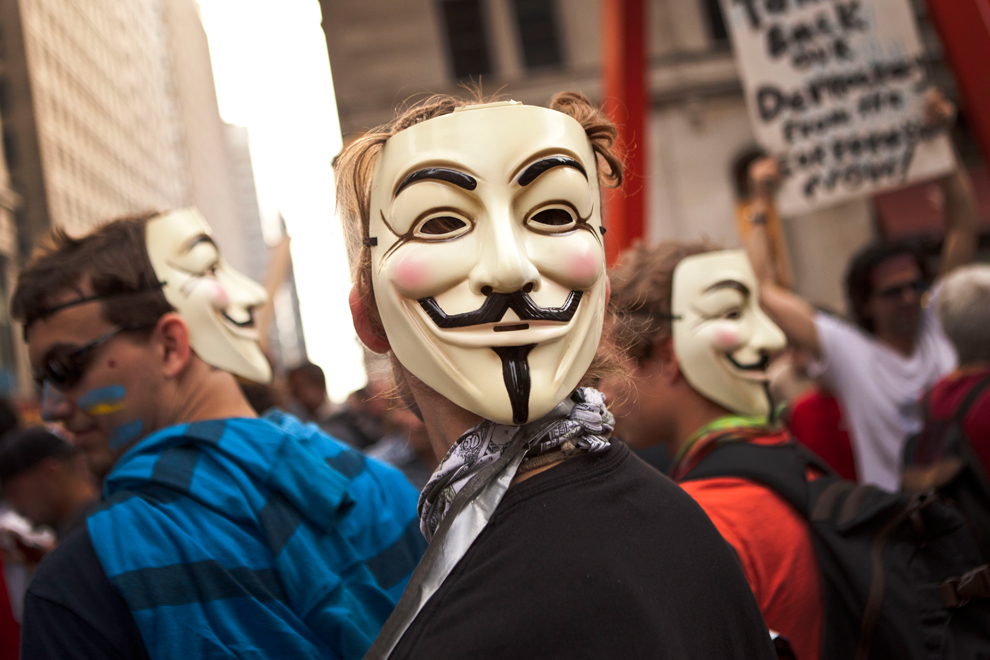
As popular revolutions and protests are gaining momentum throughout the world, there is one group particularly involved in all of them: Anonymous. The Guy Fawkes masks pervade every gathering, every riot, every protest. They're not only a sense of anonymity, but also of community and activism, spreading the word and ideals of anonymous. While still being a relatively new group, Anonymous defies all attempts at characterization and normalcy. The web-based hive mind of the Internet does not seem to have a hierarchy, a member list, or any defining characteristic of a organized group. No, Anonymous is more of a face for those on the Internet (cyber activists, vigilantes, and hackers) to assume and use for their own goals, often for freedom of speech and rights. But with this decentralized stance,one wonders how they can be effective at all?

Like everything else about Anonymous, this is the unofficial flag for the group.

They can. Anonymous has proven over the few years that it has been active, that it can and will act out against those who oppose them. Check out the Wikipedia page for anonymous. Under the activities sections there are more than 30 separate operations that were performed against various corporations, governments, and groups Anonymous views as corrupt and/or harmful to the freedom of the people. As you look closely, many things about these operations or raids become clear. Often they are associated with separate arms of Anonymous, and almost always have an activist, hacktivist, or vigilante air about them. Examples of internet vigilantism include the arrest of Chris Forcand, a convicted child predator who was under surveillance by Anonymous members, who then reported him to the police after receiving sexual propositions from him under the assumption that they were minors. This as well as the recent, direct threat against the Mexican drug cartel Los Zetas for supposedly kidnapping one of Anonymous's members. Threatened with the leaking of names/personal information of those involved, the cartel released the hostage supposedly involved with anonymous. With these examples of vigilantism also come examples of hacking "For the Lulz" and of activist support. As you can probably tell, Anonymous is totally chaotic.

Protesters affiliated with the Occupy Wall Street protest wear Guy Fawkes masks in Zuccotti Park in New York on Oct. 10. (Andrew Burton/Associated Press) # 
 But this supposed chaoticness often organizes itself into scarily cohesive groups when they feel the need arises. Example: The Arab Spring. Anonymous launched several operations to aid the popular uprising in the Middle East and  North Africa, including Operation Tunisia, and Operation Egypt. In both these cases Anonymous took down government sites during the protests, and in both cases the sites were down until the protests had ousted the government. Apart from Anonymous's obvious technical help, they also advised many rebels on how to circumnavigate their government's censors using proxies, as well as circulating information as well as protesting advice. Arguably, one could say Anonymous helped give them the tools to revolt, but that may be going a bit too far.

But while Anonymous has been growing on the ever-increasing demonstration front, they have really gained momentum with the Occupy Wall Street movement. Support has been forthcoming from Anonymous, and often they highlight scenes of police brutality by publicizing it on the web. But this seems to be their only sticking point right now, as a messenger. Anonymous spreads the word about the protests, they pass the information on across the web. But as for the threats, the promises of retaliation against the injustice and corruptness of the police, nothing has happened. But nothing needs to happen. Yet. Right now, Anonymous is doing the most good by publicizing the movement, making it known the world over and spreading it's message. That is what will help the movement grow. But once the movement has grown, then it is time for Anonymous to do what they have done in the past: Make a statement.
A protester wearing a Guy Fawkes mask look on as a Carabinieri police vehicle burns during a demonstration by the "Indignant" group in Rome, on October 15, 2011. (Reuters/Stefano Rellandini) # 
Anonymous has proven that they can make the media pay attention, make governments pay attention. But what would really help them the most would be for them to make the world pay attention with a massive event, a massive protest. If they could pull off anything like the movie V for Vendetta, a movie they idolize so much it's borderline creepy, then there would be no stopping the momentum of the popular will. But at this point that seems nowhere near possible. Anonymous has yet to do any significant works in the movement, apart from the previously mentioned role as messenger. So do they have a trick up their sleeve? Are they waiting to play their cards? Or is anything going to happen at all? Only time will tell, but it's any indication from their slogan, time might prove it true.
 
 
We Are Anonymous
We Are Legion
We Do Not Forgive
We Do Not Forget
Expect Us!