Wednesday, January 18, 2012
Blackout day gets personal
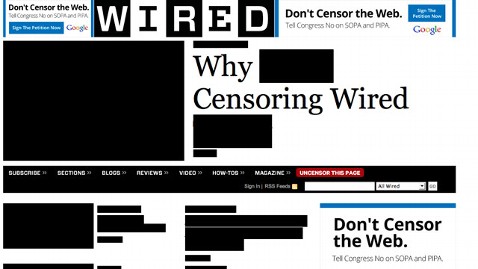
As Jan. 18th rolls around, I was left with no Reddit, no Wikipedia, and even no Rhett & Link! It was hard, but I made it through due to the importance of the cause. I somehow was able to make it through the day without Reddit, which is something previously unthinkable. Reddit also had in my opinion the best informative censorship of all the sites. I'll categorize all the sites into two different types: Informative and Censor-Shock. Informative is easy enough to understand, as the website blocks out its usual content and replaces it with information regarding the cause, including videos, links, and other information. Censor-Shock is more along the lines of Wikipedia, Google, and Wired. These sites as well as others simulating censorship with black bars and Wikipedia had a ominous all-black page. Both of these worked well in unison to create a shocking and thought-provoking surprise to regular visitors, leading to their action against the bill. Hopefully this interruption of millions of people daily routine will create an impact on this legislation.


Sunday, January 15, 2012
Explanatory SOPA Videos
A good long video that explains SOPA in a simple, visual way. Sometimes reading about it can only help so much. Sometimes analogies really help in conveying the overall idea of a topic, and in this case I think he does a pretty good job in explaining SOPA.
PROTECT IP / SOPA Breaks The Internet from Fight for the Future on Vimeo.
This video is short and to the point, covering the main aspects of SOPA, its downfalls, and the overall consequences. It looks nice, professional and would be a great introductory video to anyone you're trying to convince.
Act out against SOPA
With the
new bill SOPA rearing its ugly head you may be wondering what there is to do
about it, what actions been taken, and how you can help. Have no fear, the
internet is here! Lately many campaigns against the legislation have been
targeted at its supporters, and well as campaigns to raise public awareness.
Both of these are key in order to beat SOPA. And there is no lack of things to
do. I've found Reddit
to be a prime source of information, discussion,
and action. There they have their own SOPA subreddit,
a sub community where thousands of people discuss the bill, ways to stop it, and
any news relating to it. I've found this one of the easiest and most reliable
ways to stay informed. Also, Reddit is holding a blackout on January 18th from 8am–8pm EST. At this time Reddit
will be displaying a message alerting all visitors about the act, linking to
relevant information, and streaming the live house hearing on the bill, where
Reddit co-founder Alexis "kn0thing" Ohanian will be testifying along
with other internet experts and representatives. Reddit has also proven to be
lending a major handing in compiling all these different groups and
organizations that are taking action against SOPA/PIPA.
One such site, americancensorship.org,
has been effectively organizing meetings with senators and representatives
about the act, as well as advising people on how to go about convincing their
government representatives of the grave implications of the act. Due to this
outpouring of concern, many representatives have changed their minds about the
act after hearing from their constituents and have signed this letter against the act. This works,
representatives cannot ignore thousands of phone calls, letters, and emails
expressing concern about one act. And the more we spread the word about this
act, the more people will act against it. Time is of the essence as the house
and senate have set up the bill for a quick-pass. Do your part and act out
against it before it is too late. Contact supporters of the bill whether
they're corporations or politicians.
- List of supporting corporations
- Contact your representative
- Stay informed: 1 2
- Spread the word on Jan. 18th!
SOPA: Hypocrisy at it's Finest
Lately you may have heard some buzz around a new
bill in congress. Or you may not have, if you get your news from the main
network providers. But if you don't, and instead stay up to date by roaming the
internet, then there's no doubt that you've heard of it. The ultimate
censorship bill, SOPA
has created quite a stir by effectively promising to create an internet
blacklist and using that to block sites based off copyright terms. But the
funny thing is,
SOPA won't really be all that effective
against piracy. Piracy on the internet will always find a way and the
measures the bill proposes would not be all that effective against it. However,
they would be effective against many large, popular sites that people visit
everyday. Sites like YouTube, Reddit, Facebook, Google, and more would be
immediately affected. Why? Because all of these sites would be host to at least
one copyright-infringing document or video or picture. This would be enough
for, if a suit was filed (Which a suit can be started just due to a complaint),
then these sites would be blacklisted. This means basically any social
media-sharing site would be subject to censorship by the
government. While sites such as Facebook, Twitter, Google, Yahoo, and more
may be large enough to put up a decent defense, other smaller sites would not
be so fortunate, and would either be censored, or have to pay substantial legal
fees in order to challenge a suit.

Even large sites would not be totally invincible
from the act. Links anyone would post on any media-sharing site would have to
be processes and then censored if deemed as 'copyright-infringing'. Email
providers would start censoring emails for these infringing links, and would
remove any found. That cute cat video that you were going to send to your
grandma? Too bad sonny, that's technically owned by this one website, so
there's no way granny will ever see it. Ultimately the implications from this
bill are even worse. Ad traffic would be significantly affected, and if any
website was censored in any way, the ad revenue for that website would
immediately drop. Websites would start going offline because they weren't
making profits, and any new startups would think twice before trying to set
themselves up in that kind of atmosphere. That means SOPA would get rid of
potential jobs. Oh my, the all-mighty J-word. And we all thought politicians
loved that.
But one of the things that really bothers me about
this bill is the pure hypocrisy behind it. For years the US has been in support
of those in repressive countries and has aided them in getting around these
regime's controls. In the Arab Spring the US government fully supported
protestors and helped them to bypass these regimes firewalls to get their
message out and voices heard. We even support programs that allow people to
bypass these types of censorship, and one of the most notable causes is in
China. The Great Chinese Firewall, as it is called, has long been the bane of
internet free speech for Chinese citizens, and the US does not support it due
to this fact. So why do so many of our politicians support this bill which
shows remarkable similarities to China's
own internet censorship?
It may be due to the fact that many of these
politicians show an anti-internet bias, which is nothing new. These are old,
white men we're talking about, many of whom see the internet as a place where
people post everything illegally and where it is a lawless pit of despair. No
wonder the bill is the way it is then, as it was written in such a way to be so
legislative-languagey that normal citizens and businesses would have a hard
time understanding all the legalese. To add to this, the bill shows a
disturbing lack of understanding when it comes to the internet, both in its
fundamentals and specifics. The case against SOPA is huge, the bill poorly
written, and the consequences enormous. But the backing of it by those in power
has kept it alive and well. Hopefully this time those in power will be thwarted
before something drastic is achieved.
Sunday, January 8, 2012
Old School Debate
Although most of my sources on news in the Middle
East and other current events come from online, the fastest news source, today
I'm going old school and using The Gazette.
Not for another informative about a protest being violently repressed, or news
of occupy protestors getting tear gassed. No, today the Gazette has bestowed
upon my an interesting opinion piece on the effect of the Arab Spring on U.S.
interests and foreign policy. One of the Gazette's Pro/Con pieces, the article
is answered by Lawrence J.
Haas, part of the American Foreign Policy Council, and John B. Quigley,
professor at Ohio State University. Their opinions are both on either side of
the political center, Haas being more right-oriented, Quigley to the left.
However, though I must say I usually find my self leaning to the left, both of
them give well thought out answers and raise important points when discussing
the impact of the Arab Spring.
Haas starts off stating that the US has short term
goals and long term goals in the middle east. Short term we want to reduce
terrorism, protect allies, and support regional stability. A tall order. Long
term we want to encourage freedom and democracy in order to gain allies, reduce
threats, and expand opportunity for millions of people as well as investments.
I would agree with these points. But Haas then goes on to state that the recent
uprisings in Egypt, Libya, Syria, Tunisia, etc have given way to Islamic
radical groups that challenge everything we're working for. Groups like the
Muslim Brotherhood and the Nour Party in Egypt. He states that these groups interest
in restoring Sharia and imposing radical Islamic beliefs is a threat to the US
and the Middle East. This I would agree with to a point. It is certainly true
that radical groups pose a threat to both outsiders and others of the same
faith. Many Muslims are not radical and do not in fact welcome strict Islamic
law. This is also true of many other radical groups among other faiths as well.
Radical groups such as the Muslim Brotherhood CAN pose a threat to the
stability of the reason, but maybe not to the extent that Haas has us believe.
Basically, he is arguing these anti-western Islamic radical groups are going to
fill the power vacuums left by the dictators and create a new Middle East that
is totally against us. While that could happen, I'm pretty sure that's a
worst-case scenario, as many of the protesters and public want freedom,
something not always synonymous with restrictive Islamic fundamentalism.
Quigley takes another look at things and instead of
pointing towards the radical groups as the source of problems, he instead
points to the US as the instigators of these problems. He argues that because
of US involvement in the Middle East, we've done more harm than good. By being
inconsistent in our policy and often intervening when we shouldn't have or not
doing enough in other places, we have brought these radical groups on
ourselves. While this may be true, and he does a good job of stating specific
examples, this may be another point of blaming everything on America because
America just sucks. As always we have to take these with a grain of salt;
radical groups are a potential threat, but singling out Islamic ones will only
further increase their animosity towards us. Also, it is not always
America's fault, although we have made our share of politic blunders when it
comes to the Middle East. As long as we can find a middle ground, stay
consistent with a policy, and not meddle too much, I think the Arab Spring
could be beneficiary to the US.
Saturday, January 7, 2012
Syria: Observed
Recently
in Syria the Arab League has sent in a team of observers to monitor Syria's
uprising and the regime's promise to stop violence. However, many are not
satisfied with this opportunity for observation as the regime is leading it,
and many fear that they are misleading the observers into believing that it is
not as bad as it seemed. Reports have surfaced of the regime planting supporters in hostile areas, changing
street signs, and disguising military vehicles to make it seem like things are
not as bad as initially thought. After over nine months of protests and
violence, over 5,500 people have been killed according to the UN. And now it seems
that Syria is trying to hide all of that in this recent visit.

Arab
League monitors check Daraa, Syria, on Tuesday.
SANA/AP
|
Hiding the crimes of the regimes is nothing new, as we've
seen it before in Egypt, Libya, and even farther back to Hitler's Germany and
the Soviet Union. It is expected to have regimes hide their intentions and
actions. No regime would blatantly kill civilians and admit to it, the reaction
from the international community would be swift and forceful against them. No,
regimes will do everything in their power to quell any uprising, and even more
so to keep their actions against such a thing quiet. So it looks like it is no
different in Syria, where the regime is employing the "Act like nothing
wrong and invite them to take a look to make it seem legit" plan. However,
they will have to keep this act up as recent news has announced that the
monitors will continue to stay in Syria and observe what they
call 'mistakes'. In what could very well end up being a dangerous situation,
these monitors will have to evaluate the atrocities of the Syrian government
with the Syrian government breathing down their necks. Obviously this conflict
of interest could result in retaliation against the monitors, but I feel that
would be unlike what the Syrian government has shown so far. Based off of
Assad's attempts and other government actions, I feel the Syrian government is
trying to play it off as not something as important as most thought. Doing
anything radical against this foreign observation would go against their stance
of "openness" to the international community, and would definitely
ruin their act of "Everything's alright."
 |
| An Arab League observer takes photos of anti-government protesters on the streets in Adlb on Dec. 30, 2011. (Reuters) |
However,
it seems Syria will have a hard time convincing the Arab League observers that
everything is A-OK as violence continues to boom. Killings continued on Wednesday
as observers were still there, with 12 reportedly shot dead by security forces.
This continued violence has left some in the Arab League wary and some calls
have been made to take the observers out of harm’s way, but they will continue
to stay. However, the main reason may not be for collecting data, but rather
their presence alone has resulted in heavy arms being removed from the cities as well
as thousands of prisoners being released. The Syrian government has to try to
hide what they've been doing, and the longer the observers stay in Syria, the
longer the Syrian government has to put up this facade.Even though, violence against peaceful protests has continued and activists are skeptical about how big of an impact the observers are really having on the regime. The big question however, is what the observers will find, and what they will do with it.
Tuesday, January 3, 2012
Google's Doing it Right
Thought I'd share this cool new feature that Google now has. If you go to Google and type in Google elections (or just go to google.com/elections) it will bring up a page dedicated to news about current elections with sidebars on all the candidates, theirs parties, and the issues. But if you go to the drop done menu you can choose Egypt, where it gives you up-to-the-minute coverage of the elections going on in Egypt right now. I though it was very cool and hope to use it to it's greatest extent.Check it out!
Subscribe to:
Posts (Atom)