Wednesday, March 14, 2012

White Man's Burden Indeed

With  all the recent hubbub around Kony 2012 and the like there's been a truly amazing display of networking and human interaction surrounding it. As of right now the video has amassed 82,515,732 views. This, ladies and gentlemen, is the meaning of the word 'viral'. Having been spread around the world in such a short time, the Ugandan people have been the center of attention for millions of people now. But they are a bit overwhelmed by this recent attention given to their plight. While some of the more technological and politically inclined Ugandans knew about the Kony 2012 campaign when it first came out, most Ugandans had no idea what it was besides knowing it was a video that was raising awareness of their situation. And that overjoyed them. Just picture living through war, famine, the constant threat of gunmen kidnapping you, disease, all these unchecked horrors. And then a video rapidly circulates around the world and now people are lining up to help you and your country. It has to be a thrilling feeling, a feeling of maybe getting somewhere, getting closer to a better future, a better tomorrow. 

So they thought this Kony campaign was aiming for that, to help them get back on their feet and highlight their suffering. Yet very little of Ugandans have seen the video in question, leading to a recent drive by Victor Ochen, a victim of the Lord’s Resistance Army and a founder of the nonprofit African Youth Initiative Network (AYINET),to show them what it was all about. He and his team set up makeshift outdoor theaters so that local communities could witness the video that has sparked so much conversation on the subject of Kony and the LRA. Reports from the AYINET say that over 35,000 showed up to the northern Ugandan town of Lira to witness the screenings, and even more listened as it was broadcast over local FM stations.

Al Jazeera reporter Malcolm Webb, who was on hand to gauge people’s reactions, filed the following account:
"People I spoke to anticipated seeing a video that showed the world the terrible atrocities that they had suffered during the conflict, and the ongoing struggles they still face trying to rebuild their lives after two lost decades.
The audience was at first puzzled to see the narrative lead by an American man – Jason Russell – and his young son.
Towards the end of the film, the mood turned more to anger at what many people saw as a foreign, inaccurate account that belittled and commercialized their suffering, as the film promotes Kony bracelets and other fundraising merchandise, with the aim of making Kony infamous."


As you can see, reactions to the video were a mix between confusion and anger as they saw a white man and his son talk about an issue that happened over 5 years ago, and then trivialize it through what they saw as a cheap marketing campaign aiming to smear the facts in order to get a better profit. Imagine that, the people it claims to support and help find it insulting and belittling? What a surprise, never would have seen that coming with the whole 'White Man's Burden' and everything going on there. The fact that they started to throw rocks at the screening just goes to show how insensitive and hurtful they found it. Salt on a fresh wound, insult to injury, however you like to put it, that's what it is. In fact, a woman Webb spoke to later compared IC’s approach of selling products with Kony’s image to “selling Osama Bin Laden paraphernalia post 9/11,” which she felt would be offensive to many Americans, irrespective of how “well-intentioned” the fundraising campaign was. How true is that! The portrayal of this campaign as almost like a political campaign is stretching the limits of political correctness and shows a lack of compassion when dealing with these people and the trauma they have gone through. I think the woman hit it spot on, if this was Osama bin Laden stuff post-9/11, people would riot in the streets, and the organization would be forcibly removed from the country. I mean, why would you portray it in that way? I don't get why you have to make it cooler to get more people to buy the stuff. It comes down to a point where the more people you get on your campaign, the less of a charity it is and instead becomes another fad for these people. As the ease of assimilation into a movement increases, the meaningfulness of the movement decreases. And the meaningfulness of the Kony 2012 movement was set low for a reason: To get a larger audience and support network, plain and simple. This isn't for Ugandans, this is for success.

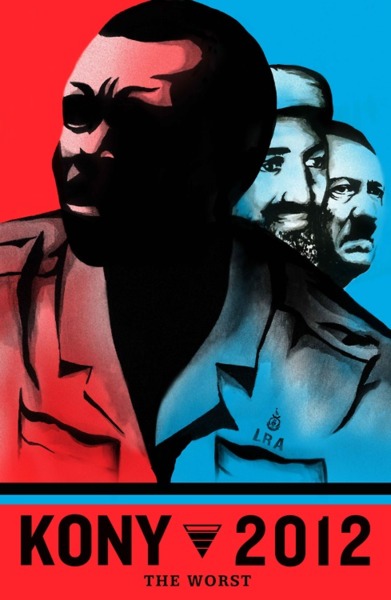
Sunday, March 11, 2012

KONY 2012- The White Man's War

KONY 2012 poster featuring Joseph Kony, Osama bin-Laden and Adolf Hitler.


If you've been on the internet at all in the past couple of days, you may have seen this poster. It's the KONY 2012 poster, recently made popular by the group Invisible Children's recent documentary that has gone viral on the internet since it's posting on Monday. Here's the video in question, a whopping 30 minutes long and chock full of... well, "information". Take a half an hour to sit down and watch this video, everyone else has and it's vital that you become informed on this subject. Because it's vital to be informed before making decisions.

Watched it? Good. Now let’s see. First reaction? Good, bad? You're probably thinking something along the lines of "This Kony guy sounds like a real d*ck." or "Yeah! People are doing something to stop this guy!" But maybe you're also thinking some other thoughts. Some not-so-positive ones. For instance, there’s been a large faction of people that have been disillusioned by this video. Why, you may ask? They find the message, the goal, and the ways the group goes about things wrong, or even sickening. That’s right, sickening. Strong word there.

You see, while this viral fad has hit people's twitter, Facebook, and RSS feeds like some sort of H1N1/AIDS epidemic, people have looked into the reasons behind its popularity, as well as the campaign itself. And they've found some disappointing things. This is The Daily What, a favorite blog of mine. As you read through the post, you can tell that people have been harassing him with messages about this campaign. But things take a surprising turn when he seems to set the record straight.

Here is what I'm going to do. I'm going to list the main concerns people have with KONY 2012 and Invisible Children. Ready? Let’s go.

1. The charity Invisible Children is under scrutiny for it's less-than-transparent financial records. (Including iffy third-party verification of their audit)

2. Only 31% of their profits actually go to programs that directly help Ugandans in Africa. The rest of the 80-some percent they say they use towards helping actually goes to their "advocacy" and "awareness" campaigns. This includes traveling expenses, salaries, lobbying, and film production.

3. Their support of the Ugandan Army, which has been accused of atrocities ranging from drug trafficking and prostitution rings to employing child soldiers. Yes, let’s pin child soldier army #1 against child soldier regime #2.

4 .Killing Kony won't do much to stop what’s going on in the region. In fact, it might make it worse since it will leave a power vacuum just waiting to be filled by many others. The region is not stable and is populated by many shady governments and regimes. Killing one guy won't help that.

5. Kony isn't in Uganda. He hasn't been since 2006, maybe even earlier. People in Uganda are rebuilding and moving on. In fact Kony is suspected to be somewhere deep in the Congolese jungle with less than 300 forces left. Not the 30,000 that the video seemed to imply. (That’s the total over the past 30 years, not the present number)

6. This campaign supports a type of activism I like to call "armchair activism". Also coined as slackivism and clickivism, this give people a way to feel good about themselves through a charity without actually doing anything at all. Sharing a link or liking a status does nothing people. If it did, breast cancer would be a thing of the past by now.

7. This campaign also promoted the "White-Savior" Complex. That being the idea that the white man, or America, is required to step in to help those who can't do it on their own. I.E., Africa and Africans. While this is more of an underlying issue, it is also a prominent one and raises more questions about what a good charity actually is. And plus this complex is built on racism. Yeah, that too.

8. The Kony 2012 campaign is often misleading and stretches the truth to send the message they want. They also dress up the presentation in order to get a better response, regardless of the actual facts.


The Most Important Reason:

Ugandans don't want this type of support and they don't like it. In fact, they think it's misleading, which can definitely be said about the campaign. They would much rather see us giving them financial and educational aid so they themselves can rebuild rather than us coming in guns a-blazing to kill a guy that’s not there.

Ugandans are also angry because this campaign has taken focus away from their own charity agencys. There are charities and organizations ACTUALLY RUN BY UGANDANS that aim to help Uganda through aid and economic reconstruction, not military intervention. And the fact that Kony 2012 is so popular angers some of them. Says TMS Ruge, co-founder of Project Diaspora: “It is a slap in the face to so many of us who want to rise from the ashes of our tumultuous past and the noose of benevolent, paternalistic, aid-driven development memes.” This view is echoed by many in Uganda and is being ignored by those who have blindly clutched to this movement. It's stuff like this that makes third world countries hate 1st world countries. We always act all high and mighty and try to fix things according to our viewpoints or what we are led to believe, but the fact remains that we may be wrong. Or even if we are right, does that give us the right to go in and fix everything? If people don't want our help we should respect that. There are obviously exceptions to that rule but in this case I think it can apply. Not to say we shouldn't be involved, I'm just saying that if they don't want our help with what we're offering as help, we should listen to what they want. And what they want isn't what KONY 2012 and Invisible Children is offering.


Thursday, March 8, 2012

Documentaries: My Weakness

So today last night as I was doing nothing at all and being rather unproductive, I decided that it would be cool to do my AP US vocab. In doing this I got to the Democratic convention in Chicago, 1968. This led to me watching some footage of the riots that took place and the severe brutality of the police. And for whatever reason I stumbled upon some videos about the 1992 LA riots in the related videos section. I became quickly intrigued as I went from video to video, watching the events I had heard about in passing a couple times before. Soon I fell upon a documentary by CNN where they went through the Rodney King trials and beating, and revisited him and how hes doing now. I would definitely suggest watching this to get a chance to see the causes behind the riots and then to look for yourself at the hours of footage on YouTube about all the looting and violence. Definitely a shocking glimpse into human psyche.

On Copyrights and Piracy

Recently in class Dr. Ayers brought a documentary to our attention, entitled Good Copy, Bad Copy. It sounded interesting to me, so I decided to check it out. I found it interesting as well as informative, definitely worth the hour of your time. Speaking of documentaries, this was one of two which I randomly decided to watch this week. I think this decision was a good one and I think you should definitely consider doing the same this week.

Saturday, February 25, 2012

Arab League's Failure

Al Jazeera offers an in-depth look at the effects of the Arab League and whether or not the UN needs to get involved in Syria since the violence has not been stopped. It raises the question whether or not these international/regional organizational bodies actually have any power in the matter and whether they can even make a difference. A good video to make time for.

Mani, the Unmasker

Recently there has been few images coming out of Syria. The government's strict crackdown has made it extremely hard for any international photographers in, and those who do get in face grave dangers. "Mani", a french photojournalist, has holed up in Homs, the center of the fiercest crackdown in Syria to date, and has taken revealing pictures that portray the civilians daily lives as they struggle to oppose their oppressive regime, all while dealing with the fear of death and the grief over those who have met it. Taking numerous precautions to protect his identity, Mani does not use his real name and covers his face with a keffiyeh (a headscarf) in order to hide his features from Syrian informants. Besides hiding from the Syrian government, Mani also has to be careful in traveling with the opposition. He has to travel with somebody at all times in order to earn the trust of those he photographs. Distrust is almost necessary there as photographers can turn out to be government informants, taking pictures of those who protest against the government in order to persecute them later. For this reason Mani makes a point to always work with someone known in the district in order to gain their trust.

Mani spent a month in Homs, Rastan and nearby rural areas, learning to avoid the routine hazards of snipers and tank fire. Photograph: Mani
Recently Mani has made a big impact on the international view on Syria, as his photographs and documentation of the conflict has been the best to come out of the region to date. Recently having two interviews with British Channel 4 and French news France24, the dangers he faces in doing so have been unveiled. The dangers of being an international journalist/correspondent are rising as conflicts become increasingly more violent and indiscriminate towards civilians and sometimes even more discriminate against the journalists themselves. However these journalists provide the clearest view on the conflicts we have, as it is their images along with those taken from the cell phones of protestors that make their way to the outside world.


Mani has also made quite an impact on me as well. With his latest short documentary film entitled "The Horror of Homs", Mani exposes the gritty details of the conflict along with the broken innocence in such a way that really got to me. When Egypt had it's uprising last year, I was moved by the footage of protestors being beaten, gassed, attacked. When they rose up, and fought back, and sang in rejoice. In Syria things are not so easy. Syria is not like Egypt, it does not go half-assed. Syria pulls out the big guns, literally, and bombs it's civilians into submission when they fight back. There is intense sadness in all of this, and yet there is still rejoicing in the face of danger. Rejoicing for the future that holds their freedom. The Syrian people show their resilience every day they face the bombardment from their own government, the humanitarian crisis they are forced to live through. Its an inspiration and a wake-up call. We have it so easy here in America, with debates over health care and religious battles. Their health care is a ramshackle field hospital set up in the basement of a bombed-out apartment building. Their religious battle is a persecution of Sunnis by alawites, and vice versa. Their government oppression is in the form of guns and bombs, not legislation and inactivity. It makes you realize how lucky you are, and how unlucky others can be. Here is the Horror of Homs.


Thursday, February 23, 2012

The Price of Journalism

         In Syria Assad's regime has been shelling and attacking Homs, along with other cities, in their fight against the so-called "insurgents". However these shellings are indiscriminate and kill more civilians than fighters. The pure terror the citizens of Homs face daily is hard to comprehend, as many are forced to take cover in basements all day in order to avoid sniper fire and mortar rounds. Food and medical aid is sparse and these people are trapped in their houses in their neighborhood, unable to do anything but hope for an end. Among these civilians are journalists trying to document the events in Homs, constantly putting their lives on the line just as the civilians do. Just this last Wednesday two international journalists were killed along with numerous others injured when a building being used as a media center was bombed by the Syrian government. US reporter Marie Colvin who was working for the UK's Sunday Times was killed in the bombardment as well as french photographer Remi Ochlik working for Paris Match magazine. The international outcry has been widespread as they mourn the loss of two remarkable journalists (Marie Colvin being known for losing an eye in Sri Lanka and for her tenacity). The day before her death Marie Colvin had described in a phone interview with the BBC that the situation was "absolutely sickening".
'She said she had witnessed the death of a two-year-old boy after he was hit by shrapnel, and said there was a "constant stream of civilians" in the field clinic she visited.
"No one here can understand how the international community can let this happen," she said.'
        The death of the two reporters has been met with international condemnation, with the US and France denouncing the events and looking into what happened. Meanwhile support for humanitarian aid and for international involvement has risen as the Red Cross tries to evacuate those seriously injured and give medical aid. Syria, of course, has been uncooperative in these attempts, although not totally against them.Other journalists injured in the blast are being treated in the primitive field hospitals they were covering just before the attack, as they are the only source of medical aid in the area. While some say this shows the indiscriminate bombing of civilians by the Syrian government, others say that it was an intentional attack against the journalists in order to stop the flow of information leaking to the outside world. whatever the case may be, this recent violence highlights the dangers journalists and correspondents face every day, as well as the dangers the people face as well.


Marie Colvin and Remi Ochlik killed in deadly assault on Syrian city as activists warn of humanitarian crisis.
         Meanwhile, medical aid is running dangerously low in Homs as well as food, and many international organizations as well as the opposition groups are trying to guarantee safe passage for humanitarian aid convoys in order to get badly needed supplies to civilians. In the meantime however, Syria continues it's bombardment of Homs in what it calls an attack against "terrorists who have been attacking civilians and security forces".